
7 CCTV Monitoring Singapore Residential Rules Every Homeowner Must Know
Mounting a camera outside your front door feels like a simple decision, until a neighbour complains that it’s pointed at their gate. CCTV monitoring Singapore residential rules exist precisely for this reason, and they’ve shifted more than once in recent years as HDB has tried to balance home security against neighbours’ privacy.
Getting the rules wrong doesn’t just risk a dispute. It can mean being asked to remove a camera you already paid to install. Here’s what actually applies today, what changed recently, and where condo residents face different rules from HDB flat owners.
TL;DR
- CCTV monitoring Singapore residential rules differ depending on whether the camera sits within your own flat or is mounted outside it, along a shared corridor.
- Smart doorbells and standalone cameras installed within your own HDB unit no longer require HDB approval, but they still can’t face a neighbour’s door or windows.
- Installing a camera outside your flat, along the common corridor itself, still requires approaching your Town Council for approval.
- Condo CCTV monitoring Singapore setups in common areas are typically managed by the MCST, not individual residents.
- Any footage capturing identifiable faces falls under Singapore’s Personal Data Protection Act, regardless of where the camera sits.
Is It Legal to Install CCTV Outside an HDB Flat?
Direct answer: Yes, but only under specific conditions: the camera must be mounted on your own door or gate, must not face a neighbour’s door or windows, and cannot be attached to the building façade itself.
This is one of the more misunderstood parts of home CCTV installation Singapore rules. Many homeowners assume any camera facing the corridor is automatically against the rules, when in fact HDB has simplified this for devices installed within your own flat. A residential surveillance setup mounted on your own front door generally doesn’t need prior approval, as long as it respects your neighbours’ privacy.
7 CCTV Monitoring Singapore Residential Rules Every Homeowner Must Know
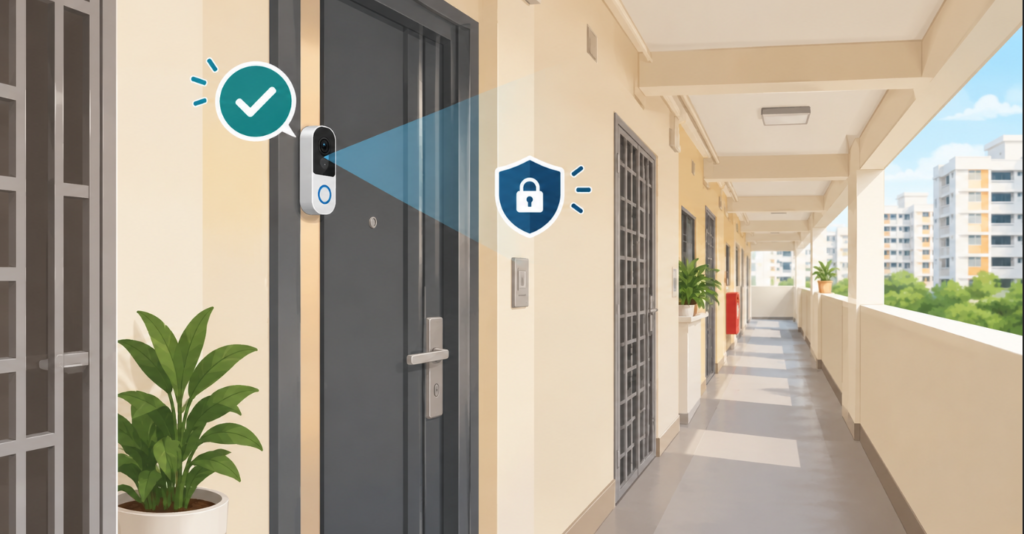
1. Smart Doorbells and Own-Door Cameras No Longer Need HDB Approval
HDB has moved away from requiring approval for smart door devices and standalone cameras installed within your own flat, recognising that these are generally less intrusive than older corridor-mounted setups. This applies to devices like smart doorbells and compact cameras fixed to your own door or gate, which fall under general home CCTV installation Singapore practice today.
2. Cameras Can’t Face a Neighbour’s Door or Windows
This is the rule most disputes come back to. Even an approved camera becomes a problem the moment its field of view captures another unit’s entrance. Before finalising placement, check the angle carefully with an outdoor surveillance setup that’s been positioned to cover only your own doorway.
3. You Can’t Mount a Camera on the Building Façade
Cameras attached directly to the building’s exterior structure, rather than your own door or gate, fall outside what HDB permits for individual flat owners. If your goal is broader coverage of your unit’s exterior, a remote video surveillance setup within your own boundary achieves this without breaching façade restrictions.
4. Corridor-Mounted Cameras Still Need Town Council Approval
If you want to install a camera outside your flat, separate from your own door or gate, along the shared corridor itself, you’ll need to approach your Town Council for guidance and CCTV camera permit HDB approval. This is different from a camera fixed to your own entrance, which typically doesn’t require this step.
5. Town Council CCTV Approval Isn’t Automatic or Permanent
Where Town Council approval is required, it isn’t a one-time formality. Historically, such approvals for corridor-facing setups have been time-limited, with homeowners needing to reapply periodically rather than assuming the installation is permanent once approved.
6. Condo Common Areas Follow Different Rules Entirely
Condo CCTV monitoring Singapore setups in shared spaces like lobbies and car parks are managed by the MCST, not individual owners. If you live in a condo and want coverage of a common corridor outside your unit, that typically goes through building management rather than a personal installation, similar to how CCTV monitoring for residential societies is coordinated estate-wide.
7. All Footage Is Still Governed by Privacy Law
Regardless of where your camera sits or whether HDB approval was required, footage capturing identifiable faces or license plates falls under Singapore’s Personal Data Protection Act. Homeowners collecting such footage have some obligations around how it’s stored and used, particularly if it’s ever shared beyond a police report.
What Are the CCTV Privacy Laws in Singapore for Homeowners?
Direct answer: CCTV privacy laws in Singapore require that home cameras don’t capture identifiable footage of neighbours without justification, and that any footage collected is handled responsibly if it involves personal data.
The Personal Data Protection Commission’s advisory guidelines set out how organisations should handle personal data captured through cameras, including collection, storage, and disposal. While individual homeowners recording for personal security purposes have more leeway than commercial operators, the core principle still applies: a camera aimed squarely at a neighbour’s door raises the same privacy concerns whether it’s mounted by a resident or a business.
Best Home CCTV System Singapore Options for Compliance
The best home CCTV system Singapore homeowners can choose isn’t necessarily the one with the widest field of view. A narrower, well-aimed camera that covers only your own doorway avoids most disputes before they start, while still giving you useful coverage through night vision monitoring for after-dark activity.
A wireless CCTV camera for home use is often the simplest way to stay compliant, since it typically mounts directly on your own door or gate without needing drilling into shared corridor walls. This keeps the installation squarely within the “own flat” category that doesn’t require Town Council involvement.
Summary
CCTV monitoring Singapore residential rules have become more flexible for cameras installed within your own flat, but the core protections for neighbours’ privacy haven’t gone anywhere. The safest approach is simple: keep your camera’s field of view within your own doorway, avoid mounting anything on the building façade, and check with your Town Council before installing along a shared corridor. Whether you’re in an HDB flat or a condo, the goal is the same, useful coverage for your own home without creating a dispute, or a data protection problem, for someone else’s.
Frequently Asked Questions
Do I need a CCTV camera permit for HDB if I only install it on my own door?
Generally no, if the camera is a smart doorbell or standalone unit mounted on your own door or gate and doesn’t face a neighbour’s entrance. Approval is more likely needed if you’re installing along the shared corridor itself.
What happens if my neighbour’s CCTV faces my front door?
You can raise the issue with them directly, seek mediation through a Community Mediation Centre, or in unresolved cases, bring a claim before the Community Disputes Resolution Tribunals.
Are condo residents subject to the same CCTV rules as HDB owners?
Not exactly. Condo CCTV monitoring Singapore rules for common areas are typically set by the MCST rather than HDB, though privacy obligations under the PDPA still apply to any footage capturing identifiable individuals.
Can I install a wireless CCTV camera for home use without approval?
In most cases, yes, if it’s mounted on your own door or gate and doesn’t face another unit’s entrance. This falls under the simplified rules for within-flat devices rather than corridor installations.
Is town council CCTV approval required for every outdoor camera?
No. It’s specifically required when the camera is mounted outside your own flat along the shared corridor, rather than on your own door or gate.
Does the Personal Data Protection Act apply to home CCTV footage?
Yes, to the extent that footage captures identifiable individuals. The PDPC’s advisory guidelines outline how such footage should be handled, even for smaller residential setups.
Can HDB ask me to remove my CCTV camera?
Yes. If HDB finds that a camera facing common areas was installed without required approval, or that it breaches privacy conditions like facing a neighbour’s door, it can require the camera to be removed.
