
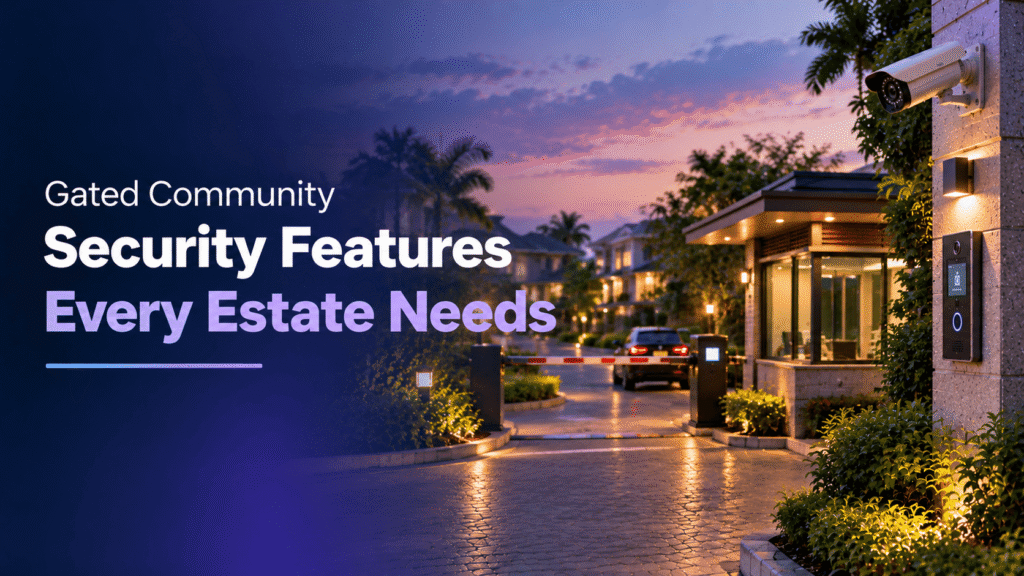
7 Gated Community Security Features Singapore Estates Should Have
A guardhouse at the entrance used to be enough to call a place “gated.” That’s no longer true. Gated community security today spans far more than a barrier and a logbook, and estates that haven’t updated their approach are often more exposed than residents assume.
Whether it’s a private landed enclave, a cluster housing development, or a large condominium estate, the same principle applies: a single checkpoint can’t cover every access point, and criminals know it. Here are the seven features that separate estates with real security depth from those relying on the illusion of one.
TL;DR
- Gated community security works best as layered coverage across every entry point, not a single guarded gate.
- Private estate security Singapore setups increasingly combine access control, live monitoring, and coordinated patrols rather than relying on manpower alone.
- Even a gated community isn’t automatically safer if side gates, car parks, or back access points are left uncovered.
- Sentosa Cove’s own security evolution shows how even a high-end private estate has had to keep upgrading its surveillance systems over time.
- Guard costs are rising, which is pushing more estates toward remote monitoring to extend coverage without expanding headcount.
Is a Gated Community Safer Than an Open Estate?
Direct answer: Yes, generally, but only if every access point is genuinely controlled. A gated community with one monitored entrance and several unmonitored side gates offers less real protection than the “gated” label suggests.
Condominiums and cluster housing count as gated communities because they typically restrict entry through guards or keycards, but the level of protection varies enormously between estates. A remote CCTV monitoring for gated communities setup closes the gap between estates that look secure and estates that actually are, by making sure every entry point is watched, not just the main one.
7 Gated Community Security Features Every Estate Should Have
1. Access Control at Every Entry Point, Not Just the Main Gate
Side gates, pedestrian entrances, and car park barriers are often the weakest links because attention concentrates on the front. Extending access control to every entry point, not just the one guards are stationed at, closes off the routes intruders actually look for first.
2. Full Perimeter Coverage, Not Just the Entrance
A camera pointed at the main gate tells you nothing about someone climbing a fence on the far side of the estate. Outdoor surveillance across the entire perimeter, including less-visible boundaries, is what actually deters attempts that don’t go through the front door.
3. Remote Guarding to Extend Coverage Beyond On-Site Staff
Rising manpower costs mean fewer estates can afford guards stationed at every access point around the clock. Remote guarding services let a smaller on-site team focus on patrols and response, while a remote operator watches feeds from every entry point simultaneously.
4. Live Verification Before Escalation
An alarm that fires without anyone checking it tends to get ignored after a few false triggers. Real-time security monitoring means a person verifies what’s actually happening before deciding whether to escalate, cutting down on wasted callouts while still catching genuine threats.
5. Two-Way Audio at Gates and Common Entrances
Being able to speak to someone at a gate before letting them in adds a layer no camera alone provides. Two-way audio surveillance allows a remote operator to question an unfamiliar visitor directly, often resolving the situation before it needs a guard’s physical presence.
6. Coordinated Intercom and Visitor Screening
Estates with multiple blocks or clusters need a way to screen visitors consistently across all of them, not just at whichever entrance happens to be staffed. Intercom monitoring ties these checkpoints together so a verified visitor at one gate doesn’t need to be re-verified from scratch elsewhere.
7. A Single Coordinated Command Point
Large estates benefit from routing every camera, sensor, and intercom into one monitored system, rather than treating each block or cluster as a separate security problem. The same principle behind CCTV monitoring for residential societies applies here: one team watching everything responds faster than several disconnected systems each covering a fraction of the estate.
How Does Gated Community Security Actually Work?
Direct answer: Gated community security works by combining controlled access points, continuous surveillance, and a team, on-site or remote, who verify and respond to alerts in real time, rather than relying on a barrier alone to keep people out.
Even Singapore’s most exclusive private estates have had to keep building on this model. Sentosa Cove and the wider island opened a Joint Command Centre years ago specifically to bring CCTV feeds from across the island into one surveillance point, allowing security staff to monitor activity continuously and coordinate with the Singapore Police Force and Civil Defence Force when needed. The lesson holds for far smaller estates too: a security system for gated estates that concentrates everything into one monitored point catches more than a collection of separate, unwatched cameras ever will.
What Does a Security System for Gated Estates Typically Cost?
Direct answer: Gated community security guard cost in Singapore varies with estate size and the number of access points, but the bigger cost driver is usually how many guards are needed to cover every entrance around the clock without gaps.
This is exactly why more private estates are shifting some of that load to remote monitoring. A residential estate CCTV monitoring setup can cover multiple entry points simultaneously at a fraction of what it would cost to staff each one with a dedicated guard, while still keeping a person in the loop to verify and respond to genuine alerts.
Choosing the Best Security System for a Gated Estate
The best security system for gated estates isn’t the one with the most cameras or the largest guard headcount. It’s the one where every access point, not just the main gate, is genuinely covered and where alerts reach someone fast enough to act on them. Before committing to a provider, ask how they’d handle an estate with multiple entrances and whether their approach can scale with something like an is CCTV monitoring worth it assessment before signing a long-term contract.
Summary
Gated community security is only as strong as its weakest, least-watched entry point. The estates getting this right combine access control across every gate, full perimeter coverage, and a coordinated team, whether on-site or remote, who verify alerts before acting. Sentosa Cove’s own move toward centralised, island-wide surveillance shows that even the most secure-looking estates keep upgrading rather than relying on a guardhouse alone. For any estate weighing its options, the real question isn’t how big the security team is, but whether every access point is actually covered.
Frequently Asked Questions
What makes a community “gated” in Singapore?
Any neighbourhood with controlled access, whether through a guarded barrier, keycard entry, or both, is generally considered a gated community. This includes condominiums, cluster housing, and private landed enclaves.
Is private estate security Singapore different from condo security?
The core principles overlap, but private estate security Singapore setups often cover larger perimeters with more varied terrain, such as landed clusters with multiple street-facing boundaries, compared to a single condo building’s footprint.
How does Sentosa Cove security compare to a typical gated estate?
Sentosa Cove benefits from island-wide coordination through Sentosa’s Joint Command Centre, which brings CCTV feeds together in one surveillance point. Most residential estates achieve a similar effect at a smaller scale through remote monitoring providers.
Does a gated community still need CCTV if guards are on-site?
Yes. Guards can only be in one place at a time, so CCTV combined with live monitoring covers the entry points and perimeter sections a physical guard can’t watch continuously.
Is remote monitoring cheaper than hiring more security guards?
Generally yes, since one remote monitoring setup can cover multiple access points simultaneously, whereas staffing every entrance with a dedicated guard scales cost directly with the number of gates.
What’s the biggest security weak point in most gated estates?
Side gates, car park entrances, and less-visible perimeter sections tend to be the most overlooked, since attention and resources are usually concentrated on the main entrance.
Can a small landed estate afford proper gated community security?
Yes. Coverage doesn’t have to mean full-time guards at every gate. A combination of access control and remote monitoring can extend meaningful coverage to smaller estates without the cost of a large security team.
