
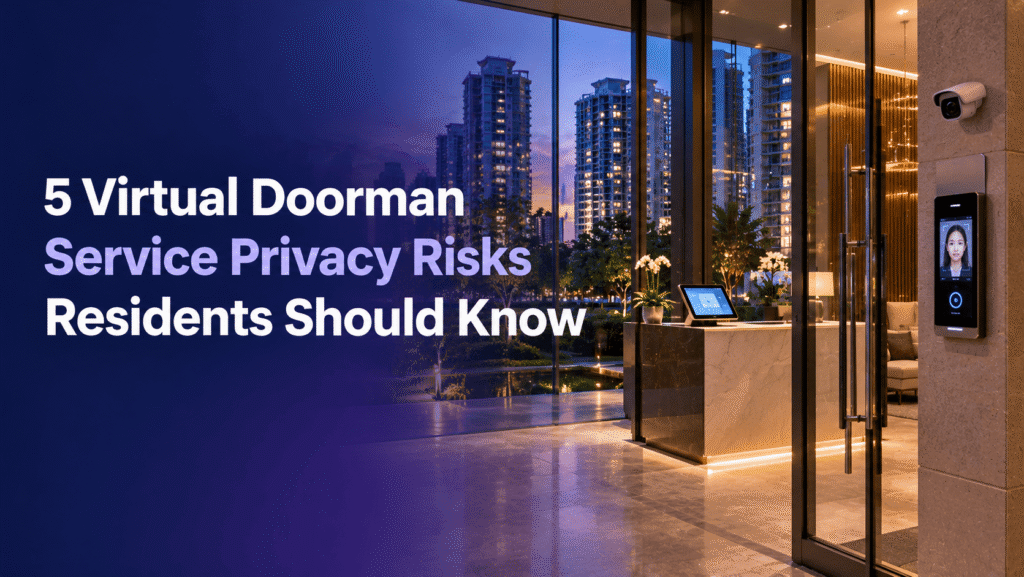
5 Virtual Doorman Service Singapore Privacy Risks Residents Should Know
Condominiums across Singapore are replacing security guards at the lobby with facial recognition panels, visitor management apps, and remote concierge desks. A virtual doorman service Singapore residents interact with daily makes entry faster and coverage more consistent, but it also collects far more personal data than a guard checking IDs at the counter ever did.
This guide covers the five privacy risks that come up most often, what PDPA actually requires, and what residents and MCSTs should check before rolling these systems out further.
TL;DR
- Facial recognition privacy Singapore concerns center on how biometric data is stored, secured, and eventually deleted.
- PDPA compliance for MCST bodies isn’t automatic just because a system is common in other condos.
- Visitor management systems create detailed logs of who enters a building and when, which residents don’t always know is happening.
- Smart intercom systems condo residents use often connect to shared networks, creating a single point of failure if breached.
- Not every condo committee has a clear policy on who can access resident and visitor data.
Why Virtual Doorman Service Singapore Systems Raise Privacy Questions
Direct answer: Virtual doorman service Singapore systems raise privacy questions because they typically collect biometric data, visitor logs, and access timestamps that didn’t exist under a traditional guard-and-logbook setup, and residents often aren’t told exactly how that data is managed.
A guard checking a visitor’s IC and writing a name in a logbook doesn’t create a searchable, centralized database. A facial recognition panel or smart condo access control Singapore system does, and that data typically sits with a third-party vendor the resident never directly agreed to share information with.
Risk 1: Facial Recognition Data Storage and Retention
Facial recognition privacy Singapore concerns are consistently the most discussed issue with virtual doorman systems. Coverage from CNA has highlighted that as facial recognition becomes more common in daily life, data security and privacy concerns grow alongside it, particularly around how long biometric templates are kept and who can access them.
For condo residents, the practical question is simple: does the MCST or vendor have a defined retention period for facial data, and is it deleted when a resident moves out? Buildings adopting virtual doorman services with facial recognition features should be able to answer this clearly, not treat it as a technical detail residents don’t need to know.
Risk 2: PDPA Compliance Isn’t Automatic
Direct answer: PDPA compliance for MCST bodies depends on how personal data collected through a virtual doorman system is handled, not on whether the technology itself is widely adopted across other condos.
The Personal Data Protection Commission’s advisory guidelines for management corporations set out how MCSTs should handle personal data collected from residents, including the need for clear purpose limitation and reasonable security arrangements (PDPC Singapore). Condos comparing virtual doorman service pros and cons should treat PDPA compliance as a vendor selection criterion, not an afterthought handled once residents start asking questions.
Risk 3: Visitor Management Systems Create Permanent Logs
A condo visitor management system does more than let a guest in — it records who they visited, when they arrived, and often how long they stayed. This creates a permanent, searchable log that didn’t exist when a physical logbook was the norm, and residents rarely see how long that data is retained or who within the management office can pull it up.
This matters most for shared households or residents who value discretion about visitors. Reviewing how a virtual concierge condo service documents and retains visitor data is worth doing before assuming it works the same way a front-desk guard’s memory once did.
Risk 4: Smart Intercom Systems and Shared Network Risk
Smart intercom systems condo buildings install often run on a shared network connecting multiple units, cameras, and access panels. This convenience comes with a trade-off: a vulnerability in one connected device can potentially expose data or access across the wider system, not just the single unit affected.
Wider reporting on facial recognition being woven into daily infrastructure in Singapore has noted the same tension between convenience and expanding data exposure as these systems scale (NBC News). Condos evaluating remote security monitoring Singapore providers should ask specifically how devices are segmented and secured against a single point of failure.
Risk 5: Unclear Data Access Policies at the MCST Level
Many condo committees don’t have a published, resident-facing policy explaining who can access facial recognition data, visitor logs, or CCTV footage from the virtual doorman system. Without this, residents have no clear way to know whether access is limited to security staff, extends to the management office, or is shared with the vendor for maintenance purposes.
A short, clearly communicated policy resolves most of this uncertainty. Reviewing how does a virtual doorman work guides before installation helps committees map out these access questions rather than addressing them reactively after residents raise complaints.
What Residents and MCSTs Should Ask Before Installing
Before a condo adopts or expands a virtual doorman system, these questions are worth resolving upfront:
- How long is facial recognition or biometric data stored, and is it deleted on move-out?
- Who has access to visitor logs and CCTV footage — security staff, management, or the vendor?
- Is the system’s data handling documented in line with PDPA advisory guidelines for MCSTs?
- How are connected devices secured against a breach affecting multiple units?
- Is there a resident-facing policy explaining all of the above?
MCSTs evaluating providers can use the complete list of virtual doorman responsibilities and duties as a starting point for building these questions into procurement rather than raising them after a vendor is already selected.
Balancing Convenience With Privacy in Condo Security
Building access control technology trends in Singapore point toward more automation, not less, so these privacy questions will only become more relevant as adoption grows. That doesn’t mean condos should avoid virtual doorman systems — it means MCSTs should treat data governance as part of the security decision, not a separate compliance task handled after the fact.
Committees weighing remote doorman vs onsite security options often find that a hybrid model, combining automated access with a documented data policy, addresses resident concerns better than either extreme on its own.
Summary
A virtual doorman service Singapore condos increasingly rely on brings genuine convenience, but it also introduces privacy risks that a traditional guard-and-logbook setup never raised. Facial recognition data retention, PDPA compliance gaps, permanent visitor logs, shared network vulnerabilities, and unclear MCST data policies are the five risks residents should understand before these systems expand further.
None of this means virtual doorman systems should be rejected outright — it means residents and MCSTs both benefit from asking clear questions upfront: what’s collected, how long it’s kept, and who can access it. Condos that document these answers before installation tend to see far fewer disputes than those that adopt the technology first and address privacy concerns only after residents start asking.
Frequently Asked Questions
Is facial recognition legal for condo entry systems in Singapore?
Yes, but MCSTs and vendors handling facial recognition data must follow PDPA requirements around purpose limitation, consent, and reasonable security arrangements when collecting and storing this data.
How long is facial recognition data kept by virtual doorman systems?
This varies by vendor and building policy. Residents should ask their MCST directly for the retention period and confirm whether data is deleted when a resident moves out.
Can residents opt out of facial recognition entry systems?
This depends on the specific building and system. Some condos offer alternative entry methods like access cards or PINs, but availability isn’t guaranteed everywhere, so it’s worth confirming with the management office.
Who can access visitor logs from a condo’s virtual doorman system?
Access levels vary by building. Some restrict visitor logs to security staff only, while others extend access to the management office or the technology vendor. Residents should ask their MCST to clarify this directly.
Are virtual doorman systems compliant with PDPA by default?
Not automatically. Compliance depends on how the specific vendor and MCST handle data collection, storage, and security, which is why PDPA advisory guidelines for management corporations exist as a reference point.
What happens if a virtual doorman system’s network is breached?
This depends on how the system is designed. Poorly segmented networks can expose data across multiple units, while properly secured systems limit exposure to the affected device or access point.
Should MCSTs publish a data policy for virtual doorman systems?
Yes, this is considered good practice. A published, resident-facing policy explaining data collection, retention, and access reduces confusion and supports PDPA compliance for the management corporation.
